|
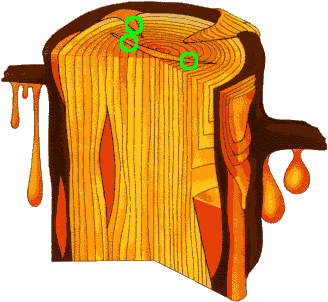
Nearly no amber drawing is more times
published than this (from Ganzelewski after Katinas): different forms of
resin accumulations on and in the amber tree.
At the resin accumulations
marked by green circles there are good chances that fine radial
spinters were cut off and got into the resin. On such splinters the features
of the wood are particularly well recognizable. (Apart from that, resin
from the interior of wood are normally without included animals.)
The three main sections
resp. views of wood: If a stem or branch is cut transverse like above in
the sketch, you get a transverse section. If the bark and a bit
more is cut away and planed, you get a tangential section. If the
stem is chopped like at the front of the sketch, you get a radial section.
|
|
Cross section
of the Baltic amber tree, varnish film photograph from Schubert (1961).
The center of the branch was somewhere right below, the bark left above.
You see the cut vessel cells (longitudinal tracheids), which grow
in exact rows from the interiour to the exteriour, as typical for gymnosperms.
M stands for one of several wood rays, that are zones of
transversal cells, here cutted longitudinally. Three big resin channels
are cutted, they ly in the same annual growth. Each annual grows begins
with bigger tracheids (early wood) and ends with smaller ones (late
wood, only few in this case).
|
|
|
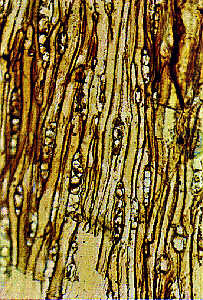
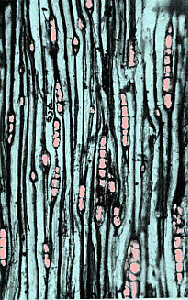
Tangential cut
of the Baltic amber tree documented by two varnish film photograph form
Schubert (1961). Opposite to the cross section above, the longitudinal
tracheids (lying vertical in a stem, blue tinted in the photgraph
to the right) are cut longitudinally. The wood rays (red
tinted) are cut transversally. Some woodrays consist only of one cell (chain),
but most of them of several cells one on the top of the other. Normally
they have only one layer of cells like here, but a few thicker ones with
several layers of cells have also resin channels which run crosswise to
the resin channels seen in the cross section seen above.
|
|