Which tree produced the Baltic amber resin?

Sorry, but a still rough English translation follows!
Debris of wood are very abundant in amber, though not liked by collectors. What is still recognizable, are splinters of coniferous wood. I do not know any rsplinters of angiosperm wood in Baltic (and Bitterfeld) amber! Most of those wood debris are the result of activity of insects resp. insect larvas. Therefore these wood debris flown out with the streaming resin are the most abundant and important remains of the amber trees.
Which other parts of the amber coniferous trees could have got into the resin and remain enclosed in it? Parts of bark, if not too large; pollen dust; male flower buds or parts of it, needles resp. leaves - bigger parts like cones derived form female flowers do not remain stucked to the resind and will not be enclosed completely.
But there seem obvious contradictions: wood and pollen grains looks like pine, but the chemistry of the amber looks like resin from araucarias, and needles resp. gymnosperm leaves are much less included as normally expected.
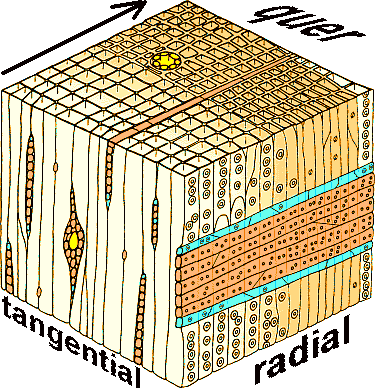
Reconstruction sketch of amber wood, changed by me after a Vorlage from R. Wagenführ. Direction of growth from the interior (front left) to the exterior (behind right) according to the arrow. A bit more than one year's groths is shown.

Above: Cross section with resin channel (yellow) and wood ray (brown). The early wood consisting of broad longitudinal tracheids is light coloured, the late wood darker ("quer" means cross-section).

 Tangential view with wood rays, one of them with a resin channel. Brown: wood ray parenchym cells, blue: transverse tracheids as components of the wood rays.

 Radial view with a wood ray consisting of parenchym cells (living storage cells, brown) with simple pits and of two transverse tracheids (blue) with small bordered pits. The longitudinal tracheids (vertical) of the early wood (lighter) have big round bordered pits.

Continue to: Wood remains in Baltic and Bitterfeld amber (1)     Back
 
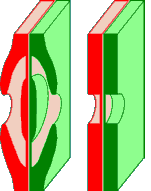
A tracheid is a very elongated cell, but closed on all sides - how can it help to transport liquids? Tracheids are dead cells - its contents are decomposed, they are so to speak empty. But they are connected to the neighbouring cells by so-called "pits", better by pairs of pits. A pit is an area of the cellular wall so thin that liquids resp. nutritional solutions can pass. Towards neighbouring tracheids, bordered pits (sketch left) are formed, both tracheids forming one half of the pit pair (red and green). A thickened section (torus) in the center of the membrane may shut the bordered pit constantly or temporary under certain circumstances. To the right, a simple pit pair as usual beteeen living cells (according to Wagenführ, modified).
Continue to: Wood remains in Baltic and Bitterfeld amber (1)     Back

Return to: