by Volker Arnold
The amber dictionary was inspired by the Museum for Archeology and Ecology PC Quiz, located at Albersdorf, Germany.
The of the
University of Hamburg has an extensive collection of Baltic amber
with inclusions, although most is not open to the public. The Amber Working
Group resides at the Geomatikum.
The University of Göttingen
contains important parts of the earlier Königsberg (Kaliningrad) collection.
Greeks, Romans and antiquity:
The Greek natural scientist, Aristotle, already knew of and reported on
amber. Pytheas of Massilia is believed to have visited the Amber Islands
(west, east, north Frisian Islands) around 334 v. Chr. The Romans, Tacitus
and Plinius, wrote about amber, its origin and trade. Emperor Nero (54-68
n. Chr.) is said to have used amber for representation purposes in large
quantities. The Romans opened the trade with Samland amber.
Amber can be ground wet
using water resistant emery paper. Grits of 180, 400 and 1000 are recommended;
only use rougher grain if much of the larger pieces shall be ground away.
The amber should be washed off before each grit change. The amber surface
in front of inclusions the amber surface should become as even as possible
(glueing sandpaper with double stick adhesive tape on a disk). Fast motor
driven grinding wheels can lead to heat damages of the amber, if there
is no supply of water.
Hardness and weight: Amber
is only little heavier than water (density around 1.07), thus sinks in
fresh water, but floats in strongly salty water. The hardness varies between
2 and 3 (Mohs Hardness Scale) and is similar to hard plastic.
Healing powers: Particularly
in earlier times amber was believed to possess welfare strength and it
was helpful to breath the smoke from burning amber incense. Amber was powdered
and prepared as an ointment; the oil distilled from amber was considered
as a cure-all remedy, particularly against rheumatism. Duke Albrecht sent
Martin Luther good amber for his 'bad' gallstone. Although amber remedies
may not be effective, it is not injurious to health!
Hobby groups: A working
group of amber collectors and researchers was founded at Hamburg, and at
present led by Dr. Weitschat from the Geological-Paleontological Institute
and Museum of the University of Hamburg. Topics include amber discovery
locations, as well as research and determination of inclusions. The group
is integrated in the promotion society of the institute and museum, meeting
a few times in a year, with dues of 75.-DM. Membership is recommended for
serious amber researchers to amber customers.
Hydraulic washing: In the
amber open pit mining (e.g. in the Samland area) amber is floated, i.e.
large quantities of water concentrate the amber when artificially washed.
Even in Poland the amber is washed out hydraulically from deeper layers
(often illegally) by means of floating drillings and then found at the
surface.
During the Ice Ages (approximately
1,000,000 years ago, in the Pleistocene), enormous continental glaciations
covered the Baltic Sea area at least six to eight times. The amber containing
layers were planed off and most accumulations of Baltic amber were reworked
again. The outwash sediment brought amber to northern Germany and Jutland,
and even to northern Holland and eastern England.
Incense: Amber can
be ignited easily with a lighter, contrary to synthetic resin, and this
burning property was the origin of the German, brennstein, which means
burning stone. The flame is brightly, reddish-brown and the burning amber
smells like a pine resin. It flows together to form a black, inflexibly
mass. In former times, amber was a popular incense, burnt to create an
aromatic smoke.
The determination of amber
inclusions
is usually so difficult, identification should be left to specialists.
Generally the arthropod evolution did not develop much since the Tertiary
Period, so modern orders can be assigned and sometimes even families.
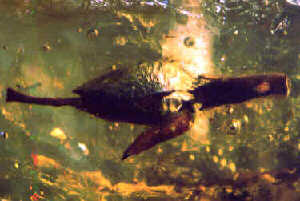
Inclusions of sea organisms:
Contrary to some believers, there are no inclusions of sea organisms in
amber. Naturally tracks and incrustations of modern sea organisms can be
found on the surface of amber floating in the sea. Entombed organisms in
amber are exclusively land inhabitants, usually of a Tertiary age, amber
forest area. There are a very few fresh water inhabitant inclusions. The
recently published is most likely a fantasy product.
"Inkluse" is a German technical
term for an animal or plant inclusions in amber. The frequent pieces
of decayed wood and stellate hairs in amber are normally not included with
this term. Inclusions are often found in " Schlauben"
and taps or stalactites.
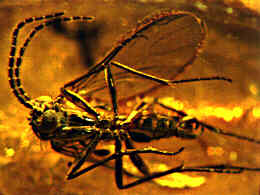
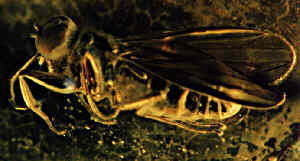
Insects: including midges,
gnats and flies, are the most frequent inclusions
in Baltic amber. Only a few preserved midges and gnats in amber are found
simultaneously with mosquitoes, which is an indirect sign of warm-blooded
animals such as birds and mammals in the amber forest.
Jurassic and Triassic: From
the older periods of the Middle Earth Ages (Triassic and Jurassic, of the
Mesozoic, 220-140 million years) there are some places of discovery of
fossil resins however, without important inclusions.
Kaffeedick, "Sprockholz":
By water, amber is washed together with other materials, which have similar
density, that is dark plant sections and small branches do not float on
water. Depending upon the form, they are called cigars, "Sprockholz" (floating
wood), or "Kaffeedick" (coffee grounds). One can search successfully in
such shore-washed deposits in the Wadden Sea and along the coast.
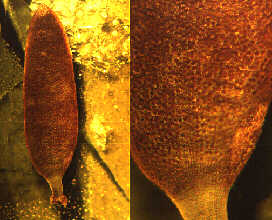
"Knochen", or bone, is the
German name of an amber type, which contains many microscopically small
vesicles. The many bubbles cause the amber to look creamy white and contains
no recognizable inclusions. It is preferable for making jewelry.
Lebanon amber, and amber
found in the adjacent sections of Jordan and Israel, is some of the oldest
amber types with inclusions, Lower Cretaceous, approximately 130 million
years. Insect inclusions reveal the early developmental history of the
amber. Bird feathers have been preserved.
Collections in Poland and Lithuania:
The castle at ,
southeast from Gdansk (Danzig), Poland, was rebuilt after the war and has
an important amber exhibition. Also the at Warsaw has an extensive amber department in its permanent
collection. At Palanga, southern Lithuania, one of the most important can be found.
Mammals and reptiles: As
a special feature a few bird feathers are preserved in Baltic amber. Hair
or fur torn off mammals can also be found, and sometimes together with
skin particles and even louse eggs. The hair identified to date has come
from small rodents or bats. An alleged mammal jaw with teeth is perhaps
more fantasy than true.
inclusions are quite rare, and often falsified.
Mass catches are accumulations
of amber with many inclusions. They show which small organisms ocurred
under same conditions at the same place and perhaps important information
(e.g. since the Baltic amber developed in quite different biotopes).
Open pit mining: For more
than one century amber from the 'blue earth' is retrieved in open pit mining,
near Palmnicken/Samland, today a part of Russia. The only open mining of
amber in the German Federal Republic near Bitterfeldin Saxonia was closed
in 1993.
Frequently mixtures of amber
pieces and synthetic resin are offered for sale (e.g. at flea markets
as amber). The cast-in amber pieces are easy to detect. Even now and then
the amber pieces still contain inclusions!
The museum at Bad Füssing,
Upper Bavaria, houses an dedicated to the amber's history of culture and crafts.
The Museum
for Archeology and Ecology Dithmarschen at Albersdorf, Dithmarschen, Schleswig-Holstein
has a small, but well explained collection of amber inclusions. A small
amber collection can be seen at the , at Burg/Dithmarschen.
, a branch of the Museum of Natural
History, has an cabinet with amber from all world. A special emphasis of
the exhibition is Dominican amber with its animal and plant inclusions.
It is worth seeing.
The name amber"
is often confused with ambra or ambergris, an aromatic mass expelled by
sperm whales. The German name "Bernstein" means burning stone ("Brennstein").
The Greek amber name "electron" is still used as the word electricity.
The Romans called amber succinum (" juice") because of a correct assumption
that it developed from tree resin. Germanic people called it, according
to the Roman author Pliny, glaes(um) or glass.
Needle test: With help
of
a glowing needle doubts can be eliminated as to whether it is
amber or a plastic imitation. It melts and evaporates a tiny part of the
surface of the piece which will be checked. The synthetic resin smell is
different to the the resinous amber smell. It is best to test on an inferior
amber piece!
North Sea amber is mostly
Baltic amber, which was partially moved to the area of the North Sea coast
prior to Ice Age rivers, by glaciation. Apart from the Wadden Sea shore,
the sand banks near St.-Peter-Ording and the west coast of Jutland are
most productive. North Danish amber might come from former amber forests
of South Sweden, and this amber's origin is also referred to as west Baltic.
Oligocene is the name
of the third of five sections of the Tertiary (35 - 26 million years).
During the Oligocene, the sea penetrated into the Fennoscandic amber forest
areas, eroded the lightweight amber and redeposited it in sandy deposits
called "blue earth".
To perforate or drill the
amber, one uses either a small drill, a drill with flexible wave, or a
flywheel drill as used by goldsmiths. The drill should have its thickest
place in front, so that it does not tilt. Twist drills must be used carefully,
since they tilt easily and can break the amber.
Perforated with glowing needle:
Some believe amber pieces could not be perforated prior to the Bronze Age,
because of the need for a glowing metal needle. But that is possible only
with very thin disks of amber, with quick and skillful workers. Amber was
surely perforated with flint drills already during the Stone Age.
Plastics: Some amber types
differ scarcely from plastics with similar colors. Sometimes it helps to
grind a bit (amber smells resinous, but synthetic resin does not) or to
prove authenticity by burning a bit, if necessary with a glowing needle.
One must remember these are destructive tests and it is best to try these
tests with inferior pieces of amber. Amber floats in concentrated saline
solution, while synthetic resins usually sink.
Before polishing an amber
piece, the surface should be ground with 600 or 1000 grit, until all of
the scratches are gone. Amber is polished using a cloth or soft leather
piece, and polishing paste (casting resin hobby accessories, although toothpaste
will work). With moderate pressure, a fine, soft toothbrush and soap will
eliminate the ugly paste remainders. Polishing materials should not come
into contact with abrasive grit or dust!
Today most smaller pieces of amber
are worked in polishing cylinders. These are hollow cylinders, filled
with amber and a sharpening or polishing agents, turning slowly for weeks.
Thus, the stones are polished all around, so that they only have to be
drilled or perforated, to use them for making necklaces. Inclusions are
relatively easy to recognize in amber from polishing cylinders, since only
few pieces must be specially ground for this purpose.
Popular literature (in
German) that introduces amber includes: Bismarck, R. v., Amber - Gold of
the North, Neumünster (Wachholtz) 1987 (Touring Museum Kiel no. 3);
Reinicke, R., Amber, Gold of the Sea. Rostock (Hinstorff) 1989; Schlee,
D., Amber News, 1984; Schlee, D., The Amber Forest, 1986; Schlee, D., The
Amber Cabinet, 1990. The booklets of Dieter Schlee are available from the
society for the promotion of the Museum of Natural History at Stuttgart.
Krummbiegel, Guenter and Brigitte: Amber, Fossil Resins from all World.
Neustadt (Goldschneck Publishing house, fossil special issue 7) 1994 (Interesting,
despite some mistakes in figure explanations, consider the correction supplement!).
New
and cheap: Manfred Kutscher, Bernstein
(amber), Putbus/Rügen 1999, 64 pages, more than 150 (!) inclusion
photos in colour. Available for 3.-DM (!!) + shipping at the society "Verein
der Freunde und Förderer des Nationalparkes Jasmund e. V". , post
box 34, D-18540 Sassnitz. See also specialist
books.
Preservation: The cavities
containing organisms and parts of organism included in the amber, are mostly
filled with liquid or air, but can still contain organic remains such as
chitin or muscle fibers. All larger animals and plant parts, which were
incompletely covered by resin, had a poor chance for preservation. Some
larger inclusions are difficult to recognize, because of reflecting fissures,
and whitish coatings caused by humidity.
"Schlauben" is the German
name of pieces of amber, which show layering boundaries. They developed
when resin flowed in intervals and covered previous resin flows. Schlauben
are mostly clear, sometimes milky, and often full of dirt and preserves
most inclusions. This amber is not suitable for jewelry manufacture.
Sicilian amber, also called
simetite, has been known since antiquity and is famous for its reddish
color. It originates from the Upper Tertiary Period, is rare, and contains
only a few inclusions.
"Sonnenflinten" are called
natural fractures in clear amber, which can cause interesting mirror effects.
Much "Sonnenflinten" are artificially produced today, termed "Blitzer"
or sun spangles.
Specialist books: More special
German literature featuring amber includes: Amber - Tears of the Gods,
Essen (Glückauf) 1996/7, 585 pages. (This was an exhibition catalog
of the German Mining Museum.) As a supplement to the exhibition catalog
of the German Mining Museum a special edition of Metalla (66) was published
in 1997, exclusively with amber topics. Both works contain extensive literature
comments. The book of A. Bachofen-Echt, Amber and its Inclusions, Vienna
1949, came out again 1996 as a completed reproduction by J. Wunderlich
publishing house, 75334 Straubenhardt. 1998 published: W. Weitschat and
W. Wichard,
Atlas of Plants and Animals in Baltic
Amber, Munich (Dr. Friedrich Pfeil Publishing, 1998, in German), 128.-DM
- the long-awaited manual! - To my opinion, the best book specially
for beginners is from Andrew
Ross: Amber, the Natural Time Capsule, London (The Natural History
Museum) 1998, with great identifying tables for amber inclusions and a
lot of photos and drawings. Other Books in English: Grimaldi, David A.,
Amber - Window to the Past, New York (Harry N. Abrahams) 1998, 216 pages.
Poinar, George O., Life in Amber, Palo Alto (Stanford University press)
1992. About Life in Dominican amber only: Poinar, George O. und Roberta,
The Amber Forest, A Reconstruction of a Vanished
World, Princeton University Press 1999.
See
also popular literature.
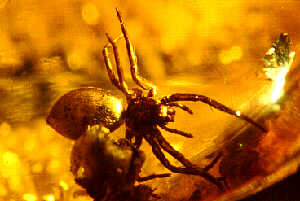
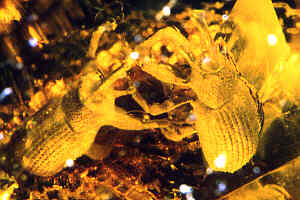
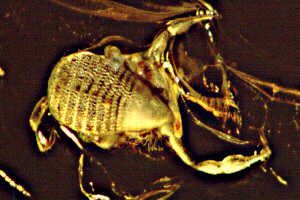
Spiders and mites are frequent
inclusions in amber. The spiders might have often
been attracted by the movement of the tiny animals sticking to the resin.
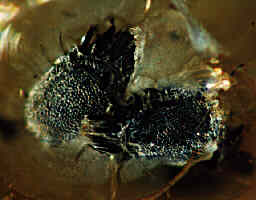
Spider webs and even animals captured by the spider may be found. Mites
next in abundance, after diptera, as the most frequent amber insect inclusions,
are often overlooked as they are very small. Even parasitic mites dependent
on birds are known.
Stalagtites or Taps (Germ.
"Zapfen") developed from resin drops, which solidified before falling down.
Renewed resin flows may transform them to thicker resin stalactites. Taps
often contain inclusions, with the cores preserving inclusions of bits
of branches. Drops have a typically flattened, roundish, bead form and
maintain a natural decomposition crust.
Stellate hairs are the
most frequent plant inclusions in Baltic and Bitterfeld amber. Those
small tufts of hairs, not recognizable with the naked eye, are thought
to be shelter hairs fallen from evergreen oaks, which grew in the 'amber
forests.' Even if only one part of the amber contains such hairs it is
an unmistakable, authentic character. Botanical remainders such as leaves,
flowers
and seed grains are comparatively rare in amber. More frequently are microscopic
pollen
grains.
Succinite is a technical
mineralogical term for Baltic amber (after Latin "succinum" or juice).
The composition and characteristics differentiate many amber types and
fossil resins from succinite.
Termites and other inclusions:
Tiny spring- tails (collembola) are frequent and as are small aphids, which
can be easily overlooked. Occassionally caddis flies are found, whose larvae
are dependent on water. Smaller representatives of various beetles
are rarely observed, likewise larva stages of grasshoppers and cicadas.
Among the rare inclusions are finds of termites, damselflies, eintagsfliegen,
butterflies, pseudoscorpios and mantises. Attention
grabbing inclusions include the few finds of fleas.
Tertiary Period: Most ambers
and other fossil resins originate from the Tertiary Period (2-65 million
years ago), including Baltic and North Sea amber. The Tertiary Period is
also the age of mammal development.
Wasps: From the insect
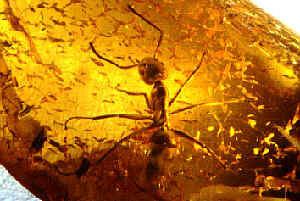
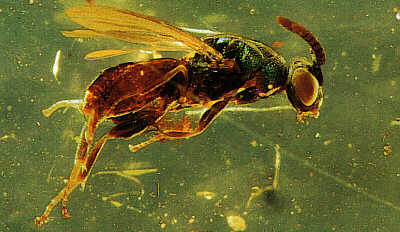
class of the Hymenoptera, ant workers and
smallest wasps occur in Baltic amber most frequently. Braconid
and chalcedonid wasps, deposit their eggs mostly into other insects
(e.g. aphids) or even into their eggs, have a body length of only 1 mm.
Weather: Amber is occasionally
found on sand beaches and in the dangerous floating ponds. Amber is found
particularly after storms, amber becomes trapped where material was washed
together and is somewhat heavier than water and does not float ('Sprockholz').
Along the Schleswig-Holstein west coast, the best finds are a few days
after stormy weather abates.