by Volker Arnold
The amber dictionary was inspired by the Museum for Archeology and Ecology PC Quiz, located at Albersdorf, Germany.
Age of important amber types:
The age of the different types of amber varies, since amber was often reworked
before its final deposition. The following values in millions of years
seem probable: 20 for Sicilian and Borneo amber, 25 for Dominican amber,
45 for Baltic and perhaps Bitterfeld amber, 70-95
for Canadian amber, 85 for Japanese Honshu amber, and 125 for Lebanese
amber, Austrian Golling amber, and Alava amber.
In the region of Alava,
Basque country, northern Spain and Salzkammergut, Austria, recent amber
finds contain insect inclusions and are Cretaceous age. One of the well-known
amber occurrences is Lower Cretaceous, near Cedar Lake, Manitoba, Canada.
Amber colophony and lacquer:
Inferior amber and amber processing waste can be made into amber colophony
or rosin and amber oil, which are both raw materials for the production
of high-quality amber varnish. Amber varnish is preferred over modern synthetic
varnishes by many.
" Amber forest" and Baltic
amber: During Eocene Epoch, Fennoscandia was a subtropical forest area,
with palms and pines, which must have had similarities to today's forests
of northern Florida or southern China. Amber inclusions also suggest cooler,
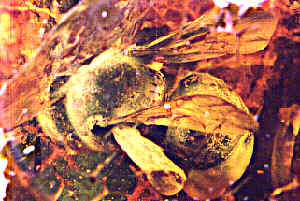
partially open, flower-rich areas (bees in amber)! A hypothesis is that
the Tertiary Fennoscandia was drained by a river system called "Eridanos,"
which flowed into the Eocene sea north of Samland through a delta, where
much tree resin was washed out and deposited as amber in flat sea sands
("blue earth").
Amber manufacturers:
You will find Schleswig-Holstein amber manufacturers at St. Peter-Ording
(Boy Jöns), Schobüll near Husum (Stegemann) as well as at Friedrichstadt
(H. Rauh). At
and at Rurup/Angeln one can find combined
amber exhibitions with old amber jewelry and amber inclusions. Stegemann/Schobüll
offer amber with inclusions.
The Amber Museum: The (between Rostock and Stralsund, Mecklenburg-Vorpommern)
is the only museum in Germany dedicated to amber. The extensive exhibition
is absolutely worth seeing and shows some outstanding amber inclusions.
Amber pine: The term
"amber pine" refers to the coniferous trees from which resin was extruded.
The Tertiary forest contained trees similar to some modern day and the
resin is thought to have come from Araucarian trees, such as Agathis, although
some scientist believe the amber pine was primarily Pinites succinifer.
In any case, around 40-90 million years ago the resin was extruded, hardened
with time, and Baltic amber was created. In resin-soaked wood shreds annual
rings can be recognized and provide evidence for a winter growth break.
Amber privilege: In the Middle
Ages, the German Order claimed the right to all amber of east and west
Prussia, because of its great value (e.g. for paternoster prayer beads).
Later this privilege called 'Bernsteinregal' was passed on the prevailing
ruling lords. Collecting amber and selling by individuals was an offense
that could result in severe punishment and death. This privilege continued
until 1945 in moderated form.
Amber Room: The Amber Room
was a complete chamber decoration, which King Friedrich I of Prussia ordered
for his Palace of Charlottenburg, near Berlin. The decoration was finished
1712. Already in 1716 he gave the amber room to Czar Peter the Great of
Russia as a gift. It was reassembled in a palace near St. Petersburg. The
room was stolen by the Germans during World War II and brought to the East
Prussian town of Königsberg (today Kaliningrad), where it probably
was burned in 1945. Again and again there are rumors, believing the amber
room is still stored in underground mines.
Amber Use by Stone Age Hunters:
Already reindeer hunters of the final Ice Age (approximately 10,000 years
BC) carved amber trailers near Hamburg, Meiendorf, and Ahrenshoeft/Nordfriesland.
In Denmark and the southern Baltic Sea area, Mesolithic hunters (8,000-5,500
v Chr) carved amber artifacts, some in the form of animal charms.
Amber Use by the Stone Age Peasants:
In the time of the Stone Age farmers (Neolithic, 3,500-1,500 BC), much
amber was collected, sacrificed or hidden (amber deposits from Jutland),
and converted to beads and trailers, placed in graves of the dead. Small
bifacial axe reproductions in amber are typical for the megalithic grave
people.
Amber trade routes: Since
the Stone Age, Baltic amber was traded with people in the south of Europe.
Imported amber was found in Greek Mykene jewelry. Up to the time around
Christ's birth, most amber came perhaps from the North Sea Coast over the
Neather Rhine to Massilia (Marseille) and Liguria or upstream the Elbe
river, towards the Adria Bay. The Samland amber was traded along more eastern
routes (e.g. over Carnuntum at the Danube or to Greece along Dnjepr and
Bosphorus).
Amber use in the Bronze and Iron
Age: In contrast to the farmer Stone Age farmer, there are fewer finds
of treated amber from the Bronze Age. Amber processing increased
during the Iron Age, when the importance of amber grew with Greek and Roman
appreciation. Beads for mixed chains, spin disks, gambling figures and dice
are known up to the Viking Age.
Amber use in medieval and
newer age: In the Middle Ages and later, much amber was used for the
production of prayer chains ("Paternoster" craftsmen). In the modern times,
amber was used in the past for decoration, representative cases, gambling
stones and boards, inlaid works, mouth pieces of tobacco pipes, among other
things. Today most amber is manufactured for jewelry, decorative accessories,
and playing chains for oriental people.
The Baltic: The Baltic
region includes the countries near the Baltic Sea, south of Finland and
east or north of Gdansk (Danzig). Baltic amber finds cover a larger area
though, which encompasses northern Denmark, west Baltic amber. Most east
Baltic amber finds are along the coast of East Prussia, Samland, west of
Königsberg (Kaliningrad, today a part of Russia). Amber can be found
along the coastline, but also in open-pit mining.
"Bastard" (hybrid) is the
German name of common amber types, which are clouded by countless holes
or vesicles, giving an opaque, milky look to the amber.The colors of the
"bastards" are between yellowish-white and ocher-yellow. "Bastards" rarely
contain inclusions and when present, the inclusions are unrecognizable.
Bees: From the insect class
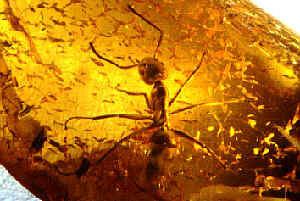
of the Hymenoptera, ant workers and smallest
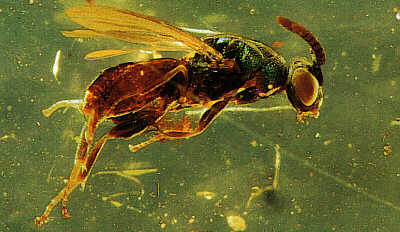
wasps occur in Baltic amber most frequently. Braconid
and chalcedonid wasps, deposit their eggs mostly into other insects
(e.g. aphids) or even into their eggs, have a body length of only 1 mm.
In addition, highly developed honey bees were found;
the existence of these bees suggests that portions of the amber forest
were flower-rich.
Beetles, weevils, bugs, caddis
flies, cicadas: The tiny spring-tails (collembola) are frequent, as
are small aphids, which can be easily over looked. Occasionally caddis
flies are found, whose larvae are dependent on water. Smaller representatives
of various
beetles are rarely observed, likewise
larva stages of grasshoppers and cicadas. Among the rare inclusions are
finds of termites, damselflies, mayflies, cockroaches, butterflies,
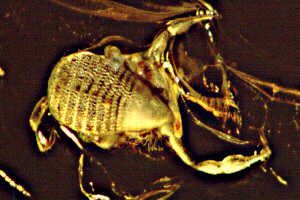
pseudoscorpions
and mantises. Attention grabbing inclusions include a few finds of fleas.
Berlin: The in Berlin possesses one of the most extensive German
amber collections, featuring Baltic amber with inclusions. The collection
is not completely open to the public, but to scientists with justified
interests. The University of Göttingen contains important parts
of the earlier Königsberg (Kaliningrad) collection.
Birds and mammals: As a special
feature a few bird feathers are preserved in Baltic amber. Hair
or fur torn off mammals can also be found, and sometimes together with
skin particles and even louse eggs. The hair identified to date has come
from small rodents or bats. An alleged is perhaps more fantasy than true.
inclusions are quite rare and are commonly falsified.
Bitterfeld amber: In brown
coal pits near Bitterfeld in Saxonia there is the only large occurrence
of amber in Germany today. It is below the Tertiary brown coal and contains
many animal inclusions, similar to Baltic amber. Some researchers believe
Bitterfeld amber to be equivalent to Baltic amber, based upon the homogeneous
fossil remains. Other researchers believe Bitterfeld amber to be substantially
younger than Baltic amber. When commercial mining was halted in 1992, the
Bitterfeld amber has been sought by amber lovers, despite of prohibitions
and the gradual flooding of the pit called Goitzsche.
"Blitzer": is the German
name of artificially reflecting fissures, which develop after 'cooking
clear' the amber in oil, followed by cooling in water. Although these sun
spangles are attractive in jewelry, many inclusions are damaged or destroyed
while making "blitzer."
Blue earth: Blue earth is
a marine deposit of Tertiary age located in Samland (East Prussia, today
part of Russia), which contains reworked amber deposits that are mined,
open-pit, near Palmnicken.
Borneo amber: Amber from
Borneo (island in southeast Asia) has been known only for a few years as
a result of coal mining. Some amber is quite large and it has a very dark
color. This amber is only half as old as Baltic amber and occasionally
contains insect inclusions.
Cigars: By water, amber is
washed together with other materials, which have similar density, that
is dark plant sections and small branches do not float on water. Depending
upon the form, they are called cigars, "Sprockholz" (floating wood), or
"Kaffeedick" (coffee grounds). One can search successfully in such shore-washed
deposits in the Wadden Sea and along the coast.
Colors of amber: Amber is
usually light to darker, golden yellow and ages to reddish or brownish
yellow, in extreme cases to red tones. Cloudy amber can be whitish yellow
or white. Depending upon contamination or formation of pyrite in fissures,
the colors may darkened. Some other amber types, particularly Dominican
amber, can occasionally be blue or green. Amber can fluoresce blue.
Combustibility, "Brennstein":
Amber can be ignited easily with a lighter, contrary to synthetic resin,
and this burning property was the origin of the German, brennstein, which
means burning stone. The flame is brightly, reddish-brown and the burning
amber smells like pine resin and flowing together to form a black, inflexibly
mass. In former times, amber was a popular incense, burnt to create
an aromatic smoke.
Conservation of amber: Since
amber weathers slowly, but constantly when exposed to air, its preservation
causes a lot of problems. Lacquer and synthetic resin coats seem to protect
the amber. Pieces with nclusions may even be cast in synthetic resin blocks,
but it is not well-known whether the synthetic resins will outlast decades
or centuries without aging also.
Cooking clear and dying amber:
Cloudy amber can be heated or 'cooked clear' in clear turnip seed oil (in
prehistoric time, piglet fat was used). Inclusions can be destroyed completely
or suffer substantial damage and occasionally they become more visible!
Artificial coloring is accomplished by penetrating the surface of the amber,
using dye to darken or turn the specimen red (e.g. for jewelry or decoration
purposes).
Copal: Copal is the name assigned
to resins that have not yet completely changed to amber. They are concentrated
in the estuaries of tropical rivers (e.g. Africa). They are geologically
younger than amber, at the most some ten thousand years old, and may contain
many inclusions. Copal becomes sticky with warmth and dissolves if one
dabs it with cotton wool and ether, and single cotton fibers will remain
stuck.
Many fossil resins are well-known
from the Cretaceous Period (70-140 million years), with interesting
animal and plant inclusions (e.g. Lebanon, northeastern America, Japan,
and the Alps in western Europe). A recent discovery of amber is situated
in Alava/Basque Country (northern
Spain), with distinctive inclusions, such as a small wasp,
an ant, and a feather.
Decay of amber: Amber weathers
constantly, particularly by atmospheric oxygen and with the influence of
light. Near to the surface it darkens upon weathering; open cavities and
fissures are constantly becoming wider, which leads finally to a rough
and crumbly surface, whereby inclusions are destroyed. Valuable pieces
of amber and special inclusions should be collected and conserved!
Density: Amber is only little
heavier than water with a density around 1.07. It sinks in fresh water,
but floats in strongly salty water.
The mosquito containing blood of
dinosaurs, which allows for the recovery of DNA for genetic engineering
of a living dinosaur, is a fairy tale! Only a few amber sites go back to
the time of dinosaurs, which died out 65 mill. years ago. If it becomes
possible to make humans out of the blood of today's mosquito, then creating
living dinosaurs may become reality!
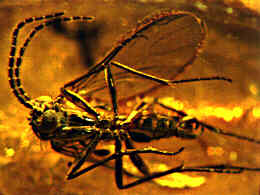
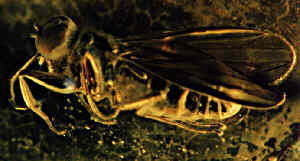
Diptera: including
midges,
gnats and flies, are the most frequent inclusions
in Baltic amber. Only a few preserved midges and gnats in amber are found
simultaneously with mosquitoes, which is an indirect sign of warm-blooded
animals such as birds and mammals in the amber forest.
Places of discovery at the
North Sea: Amber is occasionally found on sand beaches and in the Wadden
area along the North Sea, but also on land in the dangerous floating ponds.
It is found most frequently in front of St. Peter Ording and along the
west coast of Jutland; in addition, amber is found in front of Büsum
and to the east and north Frisian Islands. Amber is found particularly
after storms, amber becomes trapped where material was washed together
and is somewhat heavier than water and does not float ('Sprockholz'). Along
the Schleswig-Holstein west coast, the best finds are a few days after
stormy weather abates.
Places of discovery: Important
amber occurrences are well-known (e.g. from Japan and Canada), which belong
both to the Upper Cretaceous as well as the Lower Tertiary. Important insect
inclusions of the Lower Cretaceous are known in particular near Cedar Lake,
Manitoba, Canada. Also of Cretaceous age are recent amber finds, with insect
inclusions, from Salzkammergut in Austria and in the region of Alava, Basque
country, northern Spain.
Dominican amber: In the last
few decades, amber has been found and mined in the Dominican Republic (Carribean,
Central America). Dominican amber contains frequent large inclusions, which
originate from a later period of the Tertiary than Baltic amber. It developed
from resinous leguminous trees.
Drops or "zapfen" in German,
developed from elongate resin which solidified before falling down. Renewed
resin flows may transform them to thicker resin stalactites. Drops or taps
often contain inclusions, with the cores preserving bits of branches. Drops
have a typically flattened, roundish, bead form and maintain a natural
decomposition crust.
Amber loads itself up electrostatically,
if it is rubbed under dry conditions with a cloth or with wool. It can
actually attract paper shreds. In former times such a thing was remarkable
or even thought of as magical, because there were no plastics, as today,
with such characteristics. Thus electricity is named from amber (electron
in Greek language).
The Eocene is the name of
the second of five sections of the Tertiary (55-35 million years) and a
particularly warm time. During this time, most Baltic amber may have developed
under subtropical conditions and was redeposited by water during the following
Oligocene.
Exhibitions in Denmark: The
Geological Museum in Copenhagen has a large collection of primarily west
Baltic, Danish amber, with inclusions, but it is not open to the public.
In the prehistorical department of the National Museum in Copenhagen and
in the larger archaeological museums, there are many prehistorica amber
finds. A new amber museum with a great exhibition is situated at ,
near Esbjerg. Private amber museums, in combination with workshops,
are at Højer Vidåsluice, near Tønder, at Sønderlev,
near Hjørring, and at .
For vacationers to south Denmark, a visit in the showroom at Lakolk on
Rømø is recommended (Pedersen). At Skanör (Scania, South
Sweden), there is an interesting .
Falsifications and manipulations:
Questionable amber inclusions are already known from several collections
of the 18th century. Falsified pieces often include spectacular inclusions,
such as frogs or lizards. It is not usually worth the work to falsify the
small midges and flies. When acquiring remarkable amber inclusions, one
should be cautious if the price is unusally high and the origin uncertain.
Fennoscandia is the name
of a land massive of Tertiary age (Eocene), which was situated in the area
of today's Bottnic Bay, Baltic Sea, which includes the adjacent sections
of Sweden and Finland, and the northern Baltic. The southern section of
Fennoscandia was transgressed by the sea during the Oligocene.
Flea market amber: What
Polish and Russian dealers offer at flea markets, will usually be Baltic
amber from East Prussia and the lower Vistula area. Some of this amber
is possibly procured illegally. The low prices could be a sign of treated
jewelry, reproductions, or amber pieces cast into a pressed resin. Rosary
chain beads and raw pieces may occasionally contain small inclusions.
Flint: Inexperienced amber
searchers can mistake amber for translucent, yellow flint. Amber is softer
though and feels warm to the touch; flint is harder, and can scratch glass,
plus it feels cold to the touch.
In floating ponds or during
wet gravel dredgings on the glacial highlands or in marshlands, individual
pieces of amber may be washed together, and found at the surface. Entering
these mining ponds is forbidden and very dangerous, particularly for inexperienced
people!
"Flomen" (German name of
goose fat) is a name for clear amber, that is clouded by many medium sized
vesicles or holes. Occasionally, one can find inclusions in "flomen", if
there is a suitable view possible.
Frequency of the inclusions:
Particularly in Baltic amber termed "Schlauben",
inclusions are so frequent that one is found with every twentieth piece,
if not often. Several animal or insect inclusions may be found even in
cheap flea market amber chains, made of predominantly clear amber beads
polished in cylinders. Large inclusions are always rare and mostly discovered
before the amber is working into jewelry.